A vow can be only a few minutes long, yet it often becomes the emotional center of an entire wedding day. The key takeaways for delivering your vows are not about sounding perfect or memorizing every line without a pause. They are about creating enough space to speak honestly, look at your person, and let the meaning of the moment land.
We have seen vows whispered through happy tears in the mountains near Banff, read with shaking hands in quiet Calgary chapels, and delivered with laughter that brought an entire room closer. None of them were powerful because they were flawless. They were powerful because they belonged unmistakably to the two people standing at the altar.
Key Takeaways for Delivering Your Vows With Heart
The best vows sound like you. That may mean tender and poetic, direct and simple, a little funny, or all three. Trying to imitate a viral wedding video or write the most profound speech your guests have ever heard can pull you away from the person you are promising yourself to. Your partner does not need a performance. They need your truth.
Start by writing down the moments that changed your understanding of love: the ordinary Tuesday when they showed up for you, the difficult season you survived together, the small habit that still makes you smile. Specific memories create a vow your partner can recognize as theirs. “I promise to make coffee when you have an early morning” can carry as much weight as a grand declaration when it reflects the life you have built together.
Then make promises that are both meaningful and livable. Forever is a vast word, but marriage is also made of daily choices. Promise how you want to listen, repair, celebrate, protect time together, or keep choosing one another when life feels less cinematic. A beautiful vow holds room for the dream and the real work of sharing a life.
Write for your partner, not the room
Your guests will be moved when they witness a genuine exchange, but they are not the audience you need to impress. As you write, picture one person. What do you most want them to know before you step into marriage together?
This mindset also takes pressure off. You do not have to explain every chapter of your relationship or turn your vows into a biography. Choose two or three memories or qualities that reveal the heart of your story, then let your promises carry the rest. For most couples, one to two minutes each is enough to feel personal without losing the natural rhythm of the ceremony.
If you and your partner have not discussed your vows, talk about expectations before writing. Do you want them fully private until the ceremony? Are you comfortable with humor? Would you rather keep the tone equally heartfelt, or are you both happy for the words to take different shapes? Alignment does not mean matching scripts. It simply protects each of you from surprises that could feel uncomfortable in such a vulnerable moment.
Let Your Vows Sound Like Your Voice
Once your first draft is finished, read it out loud. Not silently. Vows live in the voice, and a sentence that looks beautiful on paper may feel too formal, too long, or unfamiliar when spoken.
As you read, notice where you naturally slow down, where your breath catches, and where the words feel like someone else wrote them. Simplify anything you would not normally say. Short sentences are not less meaningful. In an emotional moment, they can be easier for your partner to receive and easier for you to deliver.
Do not over-edit the personality out of your words. If the two of you laugh often, a warm, affectionate joke may be exactly right. If your relationship is quieter, do not feel obligated to add humor because it is expected. The emotional truth of your vows matters more than following a formula.
A helpful approach is to write freely first, then shape it into three gentle movements: what you love and have learned, the moment or memory that says it best, and the promises you are making. This gives your words direction without making them sound scripted.
Practice presence, not perfection
Practice your vows enough that the language feels familiar, but do not rehearse until every breath sounds mechanical. You are not preparing for a recital. You are making a commitment in front of the person you love.
Read them aloud several times in the week before your wedding. Practice while standing, since that changes your breathing and posture. If you tend to rush when nervous, place small slash marks in your printed copy where you want to pause. Those pauses may feel long to you, but they give your partner time to absorb what you have said.
Emotion may interrupt you. That is not a mistake. If your voice shakes, breathe. If you cry, let yourself cry. If you lose your place, look down at the page and begin again. Those unscripted seconds are often the ones you remember most vividly because they reveal how much the words mean.
Make the Ceremony Setup Work for You
Your vows deserve a practical plan, especially for an outdoor ceremony in Calgary, Canmore, or Banff, where wind, bright sun, and changing temperatures can add a little unpredictability. Print your vows in a large, clear font on sturdy paper or place them in a vow book that opens easily. Avoid relying solely on a phone. A low battery, locked screen, or notification is a small distraction you do not need.
Ask your officiant where you will stand and whether you will hold hands, face one another, or turn slightly toward your guests. Knowing the flow ahead of time helps your body relax when the moment arrives. If you are using a microphone, hold it close enough for a steady voice, even if you feel like you are speaking loudly.
It is also worth asking your officiant to remind you to look at each other. Couples naturally glance at their notes, especially when nerves arrive. Your notes are there to support you, but your partner is where the moment lives.
Give your photo and film team room to preserve it
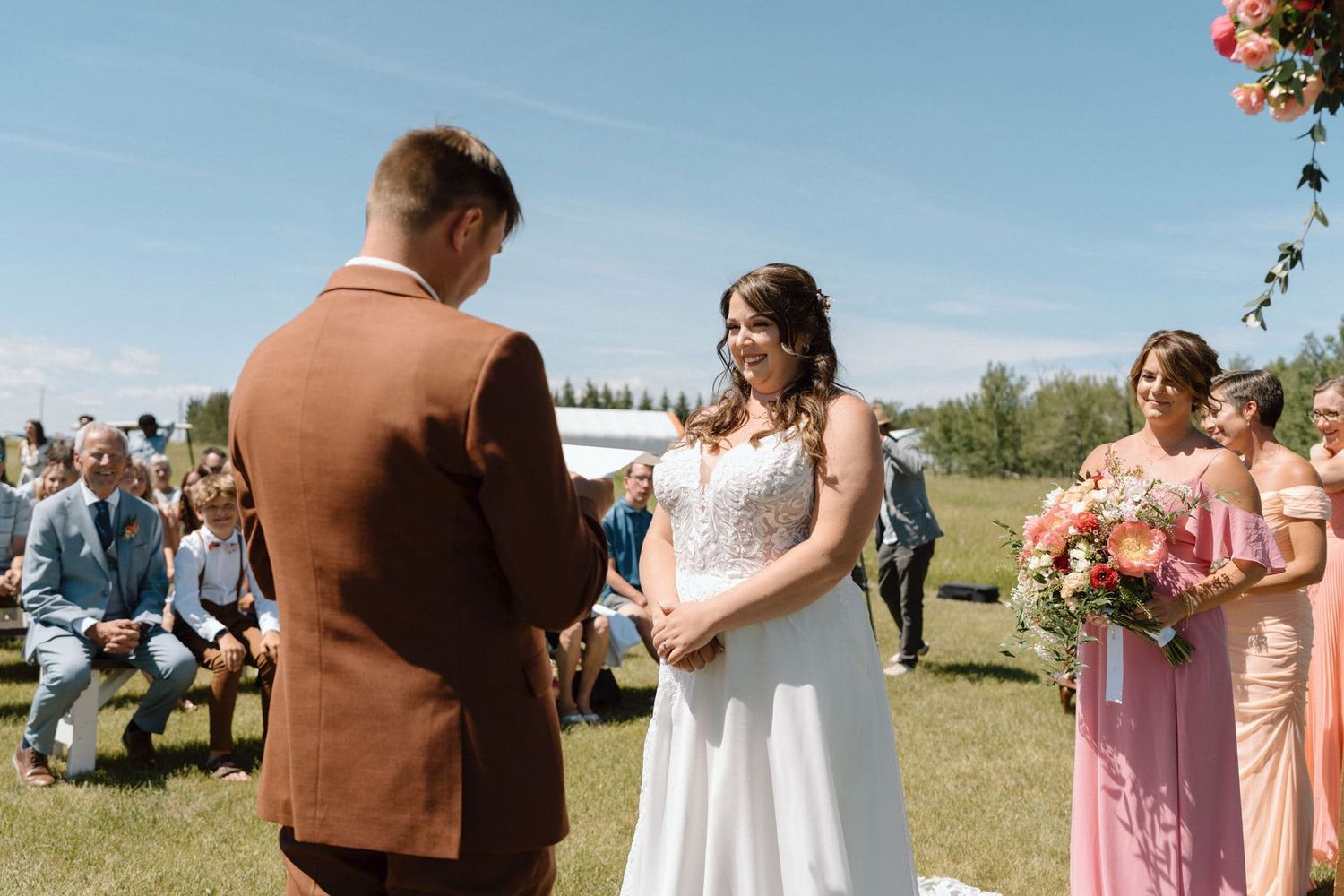
A documentary-minded photo and film team should never make your vows feel like a production. Still, a few thoughtful choices help preserve the exchange with clarity and feeling. Stand close enough to hold hands comfortably, keep your bodies gently open toward one another, and resist the instinct to turn fully toward your guests while speaking.
That small orientation lets your partner see your face and allows your loved ones to witness your connection. It also gives your visual team a chance to capture both of your reactions without interrupting the ceremony. The glance before you begin, the smile after a shared memory, the tear you try to hide - these are not distractions from the vows. They are part of the vow.
If you have chosen a cinematic Same-Day Edit, your vows may become part of the film your guests experience later that evening. That does not mean you need to speak differently for the camera. It means the room may get to relive the feeling while it is still fresh, together.
Release the Need to Get It Exactly Right
Wedding vows are intimate because they cannot be recreated. The light may shift. A page may tremble in your hands. One of you may laugh at the exact wrong moment, then laugh harder because there is no wrong moment after all.
Let the ceremony be human. Keep your notes close, take your time, and trust that the person across from you already knows your heart. Speak to them as you are, not as you think a person giving wedding vows is supposed to be. Years from now, that honesty will matter far more than a perfectly polished line.